|  |
| |


Book reviews How Alex Bloom Built Radical Democratic Secondary Education in Post-war London
(Re?) Designing Education, Ethically and Psychologically
What Are We Doing to Our Children?
A Portrait of Samuel Hartlib: In Search of Universal Betterment
Creativity in the English Curriculum
Susan Isaacs: A Life Freeing the Minds of Children
Ignorance
Education in Spite of Policy
What is Education about?
Mary Warnock: Ethics, Education and Public Policy in Post-War Britain
Enfield Voices
Who Cares About Education? ... going in the wrong direction
Grammar School Boy: a memoir of personal and social development
The Passing of a Country Grammar School
Living on the Edge: rethinking poverty, class and schooling
Education under Siege: why there is a better alternative
New Labour and Secondary Education, 1994-2010
Politics and the Primary Teacher
School Wars: The Battle for Britain's Education
Children, their World, their Education
Education Policy in Britain
School behaviour management
Supporting the emotional work of school leaders
Faith Schools: consensus or conflict?
The Professionals: better teachers, better schools
Education Policy in Britain
Who Controls Teachers' Work?
Faith-based Schools and the State
The Best Policy? Honesty in education 1997-2001
Love and Chalkdust
State Schools - New Labour and the Conservative Legacy
Experience and Education: Towards an Alternative National Curriculum
Bullying: Home, School and Community
Bullying in Schools And what to do about it
A Community Approach to Bullying
Teacher Education and Human Rights
Troubled and Vulnerable Children: a practical guide for heads
Supporting Schools against Bullying
Bullying: a practical guide to coping for schools
Financial Delegation and Management of Schools: preparing for practice
Reforming Religious Education: the religious clauses of the 1988 Education Reform Act
Re-thinking Active Learning 8-16
Two Cultures of Schooling: The case of middle schools
|
How Alex Bloom Built Radical Democratic Secondary Education in Post-war London Michael Fielding 2026 London: UCL Press available from UCL Press in paperback (£30) or hardback (£50) or as an open access (free) pdf Review by Derek Gillard
© copyright Derek Gillard 2026
He has spent more than twenty years studying the life and work of Alex Bloom (1895-1955) who became internationally known for his radical democratic pioneering work at St George-in-the-East Secondary Modern School in Stepney in the East End of London from 1945-55; and he has sought out and interviewed relatives of Bloom and former teachers and pupils of the school.
In his Foreword, David Bridges summarises Bloom's legacy. Education, he says, is a social practice 'deeply rooted in personal, social and political values' (page xiii) - values which Bloom promoted in the practice of his school and in his writing: And what values! Of co-operation rather than competition, of engagement with parents and the community, of democracy and of schools as leaders in creating a better world, not merely mirrors of society (xiii).Fortunately, he notes, 'there are many teachers and educators since then, not least Michael Fielding himself, who have kept such values alive' (xiv) despite a national curriculum which has limited the opportunities for creativity; marketisation which has turned students into customers; and an inspection regime that has stifled innovation and undermined the professionalism of teachers. So, he concludes - we still need Alex Bloom to speak to us, to inspire us and to help us build an educational system underpinned by his humane, compassionate and creative values (xiv). Fielding begins his book by describing the challenges Bloom and his school faced: the poverty of the multi-racial community it served, the extensive bomb damage it had suffered, the fact that many of its pupils had been evacuated from London during the Blitz, and the 'chronic difficulties of underfunding and the national teacher shortage crisis' (1). Yet within five years the school had acquired 'a considerable national and international reputation' (1) as it pioneered 'some of the most sophisticated democratic structures, practices and cultures ever seen in the state education sector in the UK' (2). As to Bloom himself, Fielding notes that his 'emerging reputation as a pioneering educator' was partly the result of his involvement in the English branch of the New Education Fellowship. He contributed to its journal New Era and engaged with its wide-ranging international networks. Chapter 2 is by Jane Martin. She sets out the historical background to secondary education in the post-war years, with a particular focus on London. She notes that in the 1920s few children attended secondary schools and most of those who did were presented with a narrow and academic curriculum. With the formation in 1927 of the National Association of Labour Teachers, which was strong in London, there were increasing calls for common schools for all children over the age of eleven. Labour party members, says Martin, were therefore furious with Ellen Wilkinson, Britain's first female Minister of Education, for her commitment to the tripartite system of grammar, technical and secondary modern schools. In the aftermath of the war, London's Labour-controlled authority had to deal with bomb-damaged buildings, the raising of the school-leaving age, inadequate facilities and oversize classes. Yet despite these problems, Martin notes, 'eight experimental comprehensive schools were up and running in 1945 and in 1949 George Tomlinson [Wilkinson's successor] approved the capital's first purpose-built comprehensive secondary school' (26). In chapter 3, Fielding gives an account of Bloom's life and work, noting his upbringing in the family grocer's shop and his early commitment to teaching: a course at Islington Day Training College, his first teaching post in Mile End (interrupted by service during the First World War) and his degree course at King's College London. Fielding quotes at length the comments of a London County Council inspector who described Bloom as 'one of the best teachers I have seen' (36). Bloom was appointed head of St George-in-the-East Secondary Modern School in Stepney in August 1945. His sudden and unexpected death ten years later was widely reported in the national press, and the New Education Fellowship held a meeting to commemorate his work in November 1955. 'Bloom's varied and often remarkable career as an educator', says Fielding, 'is characterised by many things, including service, diligence and respect for students' (45). Perhaps most of all we can see his intense commitment to producing better futures for students, their community and for society as a whole, and this sense of hope for a positive future was echoed in the many tributes to his life (45).In his fourth chapter, Fielding examines Bloom's commitment to radical democratic pedagogy: At the heart of Bloom's work lay a particular view of the nature of teaching, learning and education - in effect a democratic pedagogy - which exemplifies the assumptions and aspirations of radical progressive education (51).Bloom outlined his philosophy in Our Pattern, a statement of principles for St George-in-the-East School. Fielding quotes it in full (54-55) and goes on to identify four 'vibrant unifying threads that weave their way through the fabric of Alex Bloom's approach to and enactment of the development of a radical democratic pedagogy' (59). In each case, says Fielding, he not only criticised conventional practice, he gave 'positive, life-enhancing alternatives' (59). First, Bloom rejected competition, arguing in The Times Educational Supplement that 'Collaboration with and competition against are mutually exclusive concepts' (63). Second, he ruled out prizes and prize-giving as 'legitimate means of individual motivation and public affirmation' and developed 'communally based alternatives' (66). Third, he was implacably opposed, 'not just to the then normative use of corporal punishment, but to any form of punishment at all' (59). And finally, he rejected teaching as 'the dominant mode of educational encounter' (59). As he wrote in 1951: 'Relationships are the fundamental principle; not teaching methods but living methods' (74). Sara Bragg observes that 'Alex Bloom practised in his school a form of radical collegiality' (82) very much on the lines of that promoted by Michael Fielding himself who, in an article published in 1999, wrote that 'at the heart of an educative encounter there is a mutuality of learning between the teacher and the student' (82). In Chapter 5, Fielding examines Bloom's approach to the curriculum, and notes his 'openness to experiment' (86), with a range of strategies which 'affirmed, enacted and extended the fundamental values of democracy as a way of living and learning in community' (87). There were 'Guilds', a wide range of self-chosen activities in which pupils were, for example, 'players, dancers, explorers, ... artists, chefs and embroiderers' (87); Centres of Interest, based mainly on history, geography and civics; and Elective Activities, which Fielding describes as 'the pedagogic successor to guilds' (92). Elements of these strategies were later drawn together into the School Study, which Bloom described in New Era in November 1953. Its essential values, he wrote, were the promotion of curiosity and thought; the 'living experience of group working' (91); 'understanding rather than knowledge-collection' (91); and communication skills which were 'sharpened in purposeful situations' (92). A notable feature of the school was its work in the arts: consultant psychiatrist Marjorie Franklin wrote in 1962 of the 'astonishing achievements in art, drama and poetry' (94). With regard to assessment, Fielding notes 'the examples of individual and communal reflection, exchange and dialogue at the heart of Bloom's commitment to living and learning democracy' (97). He developed 'a range of structural means which enabled young people and adults to further those aspirations' (97). These included the Weekly Review, in which pupils could say whether they found lessons useful, could praise or criticise teachers, and make suggestions about future work. There were also class reporters, open days, at home afternoons (when a class would invite parents to come in), and the School Council, which, says Fielding, 'had a key role in developing and affirming the school as living instantiation of education in and for democracy as a way of life, as a way of living, learning and caring for each other in community' (104). In his sixth chapter, Fielding explores 'four companion ways in which Alex Bloom's commitment to radical communitarian democracy honoured, promoted and celebrated the multiplicity of human diversity' (113). First, he reflects on the school's development as 'a truly inclusive, diverse, democratic community, one that ... saw all children as of equal value' (113). He notes the school's 'propensity to challenge gender stereotypes' (118), so that a boy from the toughest dockland area was able to take part in a weekly ballet class without being mocked by other boys. And after Bloom's death, the Daily Mirror commented that he had 'taught hundreds of children of all races to live together' (117). Second, he considers 'the restorative narrative of shared responsibility through Alex Bloom's grounded engagement with radical psychiatry' (113). In this connection, he interviewed a number of former pupils who had benefited from 'the development of a distinctively "St Georgian" approach to special educational needs provision' (113). Third, Fielding describes the school as a 'foundational place of welcome, belonging and adventure in its nurturing of life-affirming possibility' (113). He notes Roy Nash's comment that, when Bloom spoke to the school at morning assembly, 'a recurring theme was the word "kindliness". It was his favourite word' (125). And fourthly, he explores Bloom's commitment to radical community engagement, which, he says, was an extension of his 'enduring emphasis on the interdependence of individual and communal flourishing within the school' (131). This was evident in the way he brought the local community and the school together through, for example, the School Association. School dinners, inclusive practices, dancing at lunch times, individual plans for students with particular needs, all attest to a democratic approach to education that was both holistic and liberatory (139).In the final chapter, Fielding seeks to answer the question 'How did Bloom achieve so much in such inauspicious circumstances?' (145). Part of the answer, he suggests, was the support Bloom received from the networks with which he was involved. These included the London Head Teachers Association, whose monthly newsletter he edited for five years; the English New Education Fellowship, in which he was actively involved; Goldsmiths' College, London, whose students were often placed in the school; London County Council Education Department, whose officials were strongly supportive of his work; the national schools inspectorate, whose 'glowing 1948 Inspection Report must have made criticism of Bloom's progressive methods somewhat difficult' (147); and finally, Bloom's 'connection and commitment to the local community of Stepney was also a significant resource' (146). And underpinning it all was Bloom's 'consistency of values and integrity' (152), says Fielding. He suggests that there are, today, a number of 'checkpoints of integrity which we need to attend to, reflect on and make decisions about' (152). Of these, he mentions particularly the use of language: the 'managerial colonisation of educational discourse by the hectoring machismo of "delivery"', and 'capitalism's bilious insistence on the sugared hyperbole and emotional obesity of the market' (152). Drawing on the work of one of his favourite philosophers, John Macmurray, Fielding concludes: at the heart of everything, is the question: 'how do we learn to be human?' ... Now, more than ever, we need the example of a progressive educator like Alex Bloom, because he takes us back to fundamental human values; how we live and learn together on a daily basis, to create and enjoy a better world (154).The book ends with an Appendix containing a selection of articles by Alex Bloom, chosen to represent the main strands of his thought and practice, together with a list of references and a subject index. As I finish writing this review, Alan Milburn's report on what to do about the one million 16 to 24 year olds who are not in education, employment or training (the 'Neets') has just been published. As Polly Toynbee pointed out in The Guardian (16 November 2026), these are the young people who suffered most from the Tories' austerity measures - trashing the Sure Start Centres and the Connexions youth service, cutting back on career guidance, family benefits and further education funding, closing youth clubs and leisure centres and selling off school playing fields. These are the young people whose education Michael Gove took a wrecking-ball to, removing whole swathes of creativity in music, art, drama and technology to satisfy his absurd nostalgia for an old-fashioned grammar school curriculum. These are the young people who, scarred by Covid, found that the mental health services they needed had been slashed by the Tories and whose lives have been blighted by the poison of social media with its hatred and lies and by the disaster that is Artificial Intelligence, which has even told them how to commit suicide. And as if all that were not enough, these are the young people who are now being told by right-wing politicians that it's all their own fault. As Toynbee says, 'Neets are blamed and scorned for what older generations have done to them'. What on earth would Alex Bloom have made of the state we're in today? There are some thoughts on this in the 'Reflections' by fellow educationists which follow each chapter of Fielding's book. Melissa Benn notes that many of today's secondary schools 'deploy (and celebrate) traditional forms of ability labelling, old-fashioned pedagogic methods and authoritarian discipline' (16). As a result, she says, there is 'disillusion at the widespread stress and boredom engendered within such a narrow educational model' (16). Reflection on Alex Bloom reminds us that there are very different ways of thinking about young people's capabilities, interests and possibilities. If Bloom could inspire children in the most deprived parts of East London to listen appreciatively to Schubert, to learn ballroom dancing in their lunch hour and to design their own programmes of learning, surely that points to another, far richer way of educating today's young (16).Mike Davies wonders whether features of the world today - populism, inequality, misogyny, vulnerability to propaganda and post truth - might be 'indicators of a school system that fails to help steer young people through a turbulent world and toward creating a better tomorrow' (47). Andrew B. Jones observes that current education policy limits schools' freedom to decide what to teach and how to teach it, 'leaving little space for the democratic and humanistic vision Bloom championed' (110). Forum editor Patrick Yarker argues that, three-quarters of a century after Alex Bloom's death, 'education as if people mattered does not yet exist in the educational structures, policies and processes which the state oversees in England' (142). And finally, Peter Moss observes that, under neoliberalism, 'Something has gone very wrong with education' (155). He argues that schools could be 'exciting, emancipatory and democratic places ... engaging with how we might, as societies and as a species, turn away from our present dead end and towards the possibility of a just, sustainable and democratic future' (155). Fielding's book, he says, helps us to cast off the 'historical amnesia' in which neoliberalism attempts to envelop us. It brings hope, that another world is possible, and urges on us that our task today is to work on how that world can be brought into being, knowing that if Alex Bloom could do it, in such unfavourable conditions, so too might we. We need more Alex Blooms today (156).We do indeed. There is so much to do, and Michael Fielding's book points the way to that more humane education which must be the foundation of a better, fairer society in which all can play their part. How Alex Bloom Built Radical Democratic Secondary Education in Post-war London is a remarkable book about a remarkable man. It is the product of many years of painstaking research by someone who clearly cares deeply about young people today and the world we are bequeathing them. 
|
 MICHAEL FIELDING is Emeritus Professor of Education at the Institute of Education in London and a leading writer in the fields of radical education, student voice, school improvement research and educational leadership. He worked in secondary schools for more than twenty years and has taught at the Universities of Cambridge and Sussex.
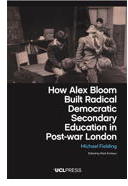 The result is How Alex Bloom Built Radical Democratic Secondary Education in Post-war London, in which he pays tribute to this remarkable man and his commitment to humanity, democracy, equality, diversity and creativity. He explains the challenging circumstances in which Bloom worked; describes the school he created; notes the international reputation and lasting legacy of Bloom and his school; and considers its significance for us today. He has also invited a number of fellow practitioners, academics and professionals to contribute their thoughts.