|  |
| |


Book reviews (Re?) Designing Education, Ethically and Psychologically
What Are We Doing to Our Children?
A Portrait of Samuel Hartlib: In Search of Universal Betterment
Creativity in the English Curriculum
Susan Isaacs: A Life Freeing the Minds of Children
Ignorance
Education in Spite of Policy
What is Education about?
Mary Warnock: Ethics, Education and Public Policy in Post-War Britain
Enfield Voices
Who Cares About Education? ... going in the wrong direction
Grammar School Boy: a memoir of personal and social development
The Passing of a Country Grammar School
Living on the Edge: rethinking poverty, class and schooling
Education under Siege: why there is a better alternative
New Labour and Secondary Education, 1994-2010
Politics and the Primary Teacher
School Wars: The Battle for Britain's Education
Children, their World, their Education
Education Policy in Britain
School behaviour management
Supporting the emotional work of school leaders
Faith Schools: consensus or conflict?
The Professionals: better teachers, better schools
Education Policy in Britain
Who Controls Teachers' Work?
Faith-based Schools and the State
The Best Policy? Honesty in education 1997-2001
Love and Chalkdust
State Schools - New Labour and the Conservative Legacy
Experience and Education: Towards an Alternative National Curriculum
Bullying: Home, School and Community
Bullying in Schools And what to do about it
A Community Approach to Bullying
Teacher Education and Human Rights
Troubled and Vulnerable Children: a practical guide for heads
Supporting Schools against Bullying
Bullying: a practical guide to coping for schools
Financial Delegation and Management of Schools: preparing for practice
Reforming Religious Education: the religious clauses of the 1988 Education Reform Act
Re-thinking Active Learning 8-16
Two Cultures of Schooling: The case of middle schools
|
(Re?) Designing Education, Ethically and Psychologically A Cause for Care Simon Gibbs 2026 Leiden, Netherlands: Koninklijke Brill BV, 179pp. Available as a download (pdf) ISBN: 978-90-04-75111-8, hardback ISBN: 978-90-04-75110-1; both €77.00 available from Brill Review by Derek Gillard
© copyright Derek Gillard 2026
He studied counselling, human relations and psychology and worked as an educational psychologist in Hartlepool. After studying for his PhD at Nottingham University, from 1997 to 2007 he was a senior educational psychologist in North Yorkshire. He began working at Newcastle University in 2000 and is currently Emeritus Professor of Inclusive Educational Psychology and Philosophy. Throughout his career, he has been concerned about what we might mean by 'education': 'what might be its purposes; could it be better, more ethical; shouldn't it be inclusive?' Sadly, he says, 'the state of education remains largely unchanged and ... the imposed culture of education in schools is still too often hostile to the well-being of both teachers and young people' (xi).
The notion of inclusion - 'recognising our interconnectedness, understanding and accepting that what we all have in common is that we are all different but need, somehow, to at least get along together' (6) - is central to his philosophy. It is an issue made all the more pressing because, he says, 'education in schools has become ... a set of institutionalised, unquestioned and, arguably, iniquitous practices based in an individualised, hierarchical and competitive curriculum' (14). He attributes much of the blame for this situation to the Education Reform Act of 1988, which 'set the stage for the marketisation of education and competition between education providers and for their clients (parents and children), setting one against another' (15). His book is about how education might become more ethical, since 'what passes for education at the moment, is often unethical and harmful to many' (18). Some obvious evidence of harm lies in the outcomes for many young people, many from certain ethnic and socio-economically deprived communities who experience rejection from school, whose lives are blighted by exclusion and meaningless educational experiences and who, in effect, may be seen as the accidental victims of a vicious cycle of deprivation (19).Education, he says, has, to date, been 'a rather poorly defined artefact that has always been "reactionary", responding to what seemed important (or not) at the time' (31). He notes 19th century hostility to the very idea of mass education and the role of, particularly, class and religion in creating divided systems: 'segregation by class (or wealth), gender, faith and needs persists in various guises' (35). He expresses concerns about the use of exclusion - both categorical (the exclusiveness of private schools, for example) and disciplinary. He notes that currently in England more than 9,000 children a year are permanently excluded from school, and 400,000 temporarily suspended (38). He argues that, rather than seeing exclusion as the product of young people's 'non-compliance', we should see it as 'a form of feedback on the nature of the educational environment they experience' (39). He discusses the views of Locke (practical skills), Rousseau (direct experience), Dewey (preparation for participation in society), and Biesta (criticism of a narrowly defined curriculum) and argues that education as presently conceptualised in the UK ... still fails to fully enable our present and future citizens to learn how to live and learn with, respect and cooperate with each other. Instead, education continues to privilege individual achievement and personal autonomy (40).The policies of successive governments have been focused on raising levels of educational attainment in academic subjects and their success has been judged by the use of tests. These tests, says Gibbs, demonstrate 'simply, inevitably and repeatedly how unequal the outcomes of children's education can be when different demographics are compared' (43). The same is true in relation to the growing number of children being excluded from school: 'the data indicate disproportionate representation of certain demographic groups; for instance, that children living in poverty are at least four times more likely to be permanently excluded from school than others' (43). This is a substantial problem, given that, as Gibbs points out, more than a third of England's children (4.3 million) grow up in poverty, and a fifth experience severe maltreatment. The lack of any serious attempt to address the effects of the injustices of socio-economic deprivation in education, he says, 'should be, it might be thought, a matter of deep public concern' (55). Thus, we may see how ethical considerations are entwined in issues of justice for all in education and, if we are to promote and instantiate more inclusive education in schools, there is a need to provide a strong argument for change (55).Not only is education structured to reflect the divisions in society, it also involves 'the unwarranted ranking of children as individuals or groups according to possibly spurious notions of ability' which may be 'emotionally and educationally harmful' (61). Thus the widespread use of setting and streaming is not 'ethically or educationally warranted' and has 'no significant effect on the subsequent rates or levels of achievement of children' (64). Similarly, there are areas which persist in maintaining segregated secondary education based on the 11 plus exam, a system which disqualifies young people 'who have not been advantaged by supportive home or school environments - or indeed coaching for the test' (66). It is claimed that grammar school pupils get better exam results at 16 and 18 and more university places. However, says Gibbs, 'systematic analyses show that, here too, these accrued "benefits" [are] largely illusory, arguably unethical and self-serving in their perpetuation of an unwarranted academic hierarchy' (66). We should also consider 'the social and emotional effects of differentiating groups by ability' (66). The language of categorization may be taken (indeed, sometimes may be intended) as locating failure as the failure of the person who 'failed' to engage; 'failed' to be motivated to learn. But it could be just as plausible, if not more so, to suggest that, as a direct consequence of central government policy and the hegemony of performativity, it was 'education' that had failed the person by gauging success solely as synonymous with academic prowess, and that that had failed to engage or motivate 'disaffected' young people or value and respect their achievements in other domains (67).Instead of the competitiveness which currently exists within and between schools, would it not be better, asks Gibbs, 'to conceptualise education as grounded in human relationships in which we learn how to be with others as cooperative co-learners in communities of learning' (69). In a just society, this will involve acknowledging the need for the recognition of human capabilities and dignity. He notes the work of (among others) Nussbaum, who was explicit that we should 'enable and include consideration of the entitlement of all to the development of a dignified life, especially those with asymmetry of needs, those disabled by neonatal catastrophes whose unusual needs may otherwise exclude them from contact with others' (77). The penultimate chapter of the book is 'a synthesis and development of the issues discussed in the preceding chapters' (87): it is effectively the kernel of the book. Here, Gibbs brings together all his arguments underpinning a possible ideal aim for education, and presents them formally in three sets of axioms. The first group summarises 'what might be ... the premises for our consideration of our individual, group and societal responsibilities and respect for others'; the second group is 'a more detailed critique of the ethics of current educational systems'; and in the third group, Gibbs suggests 'how education might be different and more ethical' (89). Gibbs ends his book with a summary, some conclusions and suggestions. The need to educate for the future, he says, is now urgent: As the planet gets hotter ... and as the climate becomes more hostile, as sea levels rise and both agricultural and populated lands are flooded, increasing numbers of people will seek safer ground and there may be, therefore, ensuing conflict about who we can tolerate living 'next door'. It is with this in mind that I have wondered if education and schools might have a greater part in helping us understand each other's situation and needs? (164)He considers three inter-related topics: the education of teachers, the curriculum, and how teaching and learning are conceptualised and implemented. The education of teachers, he says, is almost exclusively focused on what they will be required to teach and how to assess their pupils' academic progress. Student teachers get very little time to consider 'the diversity of children's dispositions, characteristics, interests, and circumstances' (166). As a result, when they are 'confronted with "difference" in all its plenitude and the constraints of what they are required to teach, many teachers become confused and professionally disabled, and the rate of attrition from teaching becomes quite understandable' (166). And why, he asks, do we think teachers can be trained in just one year? With regard to the curriculum, he suggests that we need to think again about 'what is relevant and motivating for children; what makes them want to learn and feel rewarded and valued as participants' (168). Since we are dependent on one another for our development and well-being, schools should be 'a forum where learning how to be with others cooperatively, learning about relationships, are central and necessary themes' (169). In his section on how we might conceptualise learning and teaching, he stresses the value of 'cooperative learning structures' in which the role of the teacher would be less that of a 'pedagogue' and more of a form of 'scaffolder' in the process of children's learning. Such a change, suggests Gibbs, could 'revitalise teaching as a career' by enabling teachers to 'regain the creativity, autonomy and advocacy for the well-being of young people that have all been eroded' (172). Gibbs ends his book with a some thoughts about the ethos of education. He argues that we need to address the culture of performativity in schools. He questions whether it is possible - or even desirable - to 'quantify and measure the quality and importance of human relationships that are the basis for everything in and for the purposes of education' (173). We need to recognise 'the futility and sterility of grafting the cult of performativity on anything, most especially not on education' (173). Can we imagine, he asks, 'a world in which children and young people routinely clamour to get to school', wanting to engage with 'teachers who inspire them to learn, respect and understand each other' (173), and keen to help solve some of the problems that face the world and its inhabitants? What might it take to create such an environment? Do we care enough about the future for children, young people and the future of society to redesign education radically enough? (173) 'The only thing we learn from history', said Hegel, 'is that we learn nothing from history'. I was reminded of this quote as I read Simon Gibbs' book. He asks if we can imagine a world in which 'children and young people routinely clamour to get to school' (173). I did my teacher training in the mid 1960s, a time of great creativity and innovation in education. One of my periods of teaching practice was at Bampton CE Primary School in Oxfordshire, where the head teacher, Bob Smith, was a member of the Central Advisory Council which produced the 1967 Plowden Report on Children and their Primary Schools. Child-centred education was very much in evidence at Bampton. The school day began with 'choosing time' - an hour when children could pursue their own interests. Many of them enjoyed this so much that they often came into school early. Gibbs endorses Biesta's view that we should not pursue 'a narrowly defined curriculum for all' (41) and agrees with Dewey that 'children should be active participants in their own learning' (39). We need, he says, to think again about 'what educational practices might most appropriately structure, encourage and support learning' (168). In the 1970s I taught at Bective Middle School in Northampton, which had previously been a boys' secondary modern school. Under the leadership of John Allsebrook, the staff had discussed at length what the philosophy and ethos of the new school should be, and they had created a school in which there were few set lessons. Pupils planned their own learning in their Weekly Record Books, with guidance and support from teachers, and pursued topics of their own choosing using the school's 'Basic Study Method'. I remember asking a teacher from the nearby upper school how Bective pupils compared with those of a neighbouring, very traditional, middle school. 'Well', he said, 'if I were to ask them what the equator was, the pupils of the other school would know; the Bective pupils probably wouldn't, but they'd know how to find out, and that's actually much more important, isn't it?' Gibbs argues for 'cooperative learning structures' in which students are presented with 'tasks that engage and stimulate them'. By learning to 'recognise and validate each other's different skills and knowledge' they learn 'both with and about each other (about the diversity of humanity) as well as acquiring the implicated knowledge, skills and conceptual aspects of the task' (169-171). In the 1980s, as head of Christ Church CE Middle School in Ealing, I was impressed by the Collaborative Learning scheme then being promoted by ILEA. Groups of children (chosen to represent a wide range of abilities, interests and backgrounds) were given tasks (doing a piece of research etc), with each child in a group being given a different set of resources and information. The task could only be completed if the children collaborated. It was a lovely scheme - each child felt included and valued. And finally, in an age when the far-right is threatening the survival of democracy itself, Gibbs emphasises the importance of 'helping young people discover, experience and value democratic participation' (108). In the 1990s I was head of Marston Middle School in Oxford. We established a School Bully Court*, with each class electing a member. These twelve children wrote the Rules and Procedures of the Court and impressed the staff with their good sense. We also included elected pupil representatives on a number of staff working parties, including the one which produced the school's Discipline Policy. In the entrance hall we displayed a poster which said 'This is Your School and here is how you have your say in running it'. There followed a list of the pupil representatives on the various working parties. So, over the course of my career I saw for myself the effectiveness of schemes based on the ideas in Simon Gibbs' book. Sadly, such schemes were lost in a morass of testing, targets and league tables following the 1988 Education Reform Act, which not only turned education into a competitive market, but led to the increasing use of setting and streaming 'despite the lack of evidence of beneficial academic outcomes and the real evidence of social disadvantaging' (66), and reduced teacher training to 'delivering' the National Curriculum, restricting teachers' 'autonomy, professionalism and creativity' (112). As Hegel said, we learn nothing from history ... I enjoyed reading (Re?) Designing Education, Ethically and Psychologically and, as I hope you can tell from the above observations, it made me think - which is, I suppose, the aim of any serious book about philosophy. Oh, and incidentally, I have no idea what 'fronted adverbials' are, but I seem to have survived 80 years without knowing! My only disappointment about Gibbs' book relates to its price. €77.00 (about £67) for the hardback version is not exceptional these days, but couldn't the downloadable pdf version have been cheaper? It's a shame, because it's a book which deserves to be widely read - not least by student teachers.
*For further information on this, see my article Facing the Problem of Bullying in Schools. 
|
 SIMON GIBBS began teaching in 1973. He'd been working as a scaffolder on a building site when he saw an advert for a maths teacher in a school near his old hometown. He had a degree in maths and chemistry so he applied and got the job. 'This was because I was, I later learned, the only applicant, and they needed someone in post when term started the following week' (page ix). He worked mostly in comprehensive schools but also, briefly, in a secondary modern school, where he saw at first hand the effects on children and staff of the arbitrary labelling of children who had 'failed' the 11 plus.
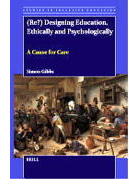 In (Re?) Designing Education, Ethically and Psychologically he explores these themes in some depth and in the context of global issues - the climate crisis, the threats to democracy, and the future in general. He acknowledges that 'what we do in schools today cannot directly, immediately affect global events', but he argues that helping young people 'to understand each other more respectfully and more hospitably', might enable us 'to avert complete, irreversible social catastrophe' (4). Whereas teaching primary school pupils about 'fronted adverbials' (as was required by former education secretary Michael Gove) will do nothing 'in itself or even in cahoots with other ill-considered educational and social policies, to avert disaster' (4-5).