|  |
| |


Burnham (1951) Harry Levy-Lawson (1862-1933) became Viscount Burnham in 1916. In 1919 Board of Education President HAL Fisher appointed him the first chair of the committees set up to settle teachers' pay, which became known as Burnham Committees.
See also the 1925 Burnham Report on The Training of Teachers for Public Elementary Schools.
The text of the 1951 Burnham Report was prepared by Derek Gillard and uploaded on 23 September 2026. |
The Burnham Report (1951) Scales of Salaries for Teachers in Primary and Secondary Schools Report of the Burnham Committee chaired by Sir Malcolm Trustram Eve London: HM Stationery Office [cover] 
MINISTRY OF EDUCATION on Scales of Salaries for Teachers in
1951 1951 PRICE 1s. 6d. NET [inside front cover]
[page i] Authorities and Associations of Teachers on in Primary and Secondary Schools 1951 1951 [page ii]
[page iii]
[page iv]
JOINT HONORARY SECRETARIES: W. P. Alexander, Esq., Ph.D., Ed.B., M.A., B.Sc., Authorities' Panel.
*Now resigned from the Committee and replaced by W. J. Deacon, Esq., M.A. [page v] 13th December, 1950. MY DEAR MINISTER, Notice having been given to terminate as from 31st March next the scales of salary at present in force for teachers employed by local education authorities in Primary and Secondary Schools, the Burnham Main Committee have, during recent months, been considering revised scales which they should recommend as suitable to take the place of those which are now in operation. At their meeting on the 8th December, 1950, the Committee resolved that new scales, as set out in the document which is enclosed with this letter, should be submitted to you. It is hoped that you will indicate your approval of the Committee's recommendations. A fuller document containing detailed provisions in regard to such matters as the method of applying the scales is in course of preparation. I hope to be in a position to submit that further report to you in the course of the next few weeks. Yours sincerely,
The Rt. Hon. George Tomlinson, P.C., M.P.,
[page vi] 9th January, 1951. DEAR SIR MALCOLM, You sent me on 13th December a summary of the scale of salary which the Burnham Committee have recommended should take the place from 1st April next, of the scales at present in force for teachers employed by local education authorities in primary and secondary schools. You said at the same time that a further Report, containing a number of detailed provisions, would be submitted in a few weeks' time. I am glad to be able to tell you at once that the scales recommended by the Committee are such as I should be able to approve. When I receive the further Report which you mention I have every hope that I shall be able to give it definite approval and to make the necessary Order. Yours sincerely,
Sir Malcolm Trustram Eve, Bt., K.C., M.C., T.D.,
[page vii] 5th March, 1951. MY DEAR MINISTER, The Standing Joint Committees on Scales of Salaries for Teachers, which later became known as the Burnham Committees - (i) Elementary, (ii) Secondary, (iii) Technical - were set up in 1919 following a meeting of representatives of Local Education Authorities and Teachers convened by the President of the Board of Education. The Committees were reconstituted in 1944 as two Burnham Committees, one Committee (Burnham Main Committee) to deal with the salaries of teachers in Primary and Secondary Schools and County Colleges, the other (Burnham Technical Committee) with the salaries of teachers in Technical, including Commercial and Art, Colleges and Schools. Reports of these two Committees for the period 1st April 1945 to 31st March 1948 were approved under Section 89 (1) of the Education Act 1944, on 8th October 1945, and further reports on 28th January 1948. You will remember that on 13th December last, I indicated that notice had been given to terminate the operation of the scales at present in force and I sent you a summary of the scales of salary which the Main Committee have recommended to take the place, from 1st April next, of the scales at present in force for teachers employed by Local Education Authorities in Primary and Secondary Schools. At the same time, I said that a fuller document containing the detailed provisions such as the method of applying the scales was in course of preparation. On January 9th you told me that the scales recommended were such that you would be able to approve and that when you received the further Report you had every hope that you would be able to give it definite approval and to make the necessary order. I now submit for your consideration and approval the Committee's full Report which embodies their recommendations. Yours sincerely,
The Rt. Hon. George Tomlinson, P.C., M.P.,
[page viii] 13th March, 1951. DEAR SIR MALCOLM, I am writing to thank you for your letters of 5th March, 1951, with which you sent me Reports containing the detailed recommendations of the Burnham Main Committee on scales of remuneration for teachers in Primary and Secondary Schools and those of the Burnham Technical Committee for teachers in Establishments for Further Education. I am glad to be able to inform you that I approve the recommendations contained in these two Reports and that, in pursuance of the provisions of Section 89 of the Education Act, 1944, an Order will be made in respect of the new salary scales which will come into operation on 1st April, 1951. The Reports will be printed and published as soon as possible. I should like to express to you and to the members of both Committees my best thanks for the time and energies which you and they have devoted to this task, and my appreciation of the co-operative spirit which has led to the successful conclusion of the negotiations. Yours sincerely,
Sir Malcolm Trustram Eve, Bt., K.C., M.C., T.D.
[page 1] SECTION A GENERAL DESCRIPTION OF THE CATEGORIES OF TEACHERS AND SCHOOLS TO WHICH THE SCALES OF SALARY ARE APPLICABLE 1. The scales of salary apply to teachers (other than Supplementary teachers or Occasional teachers) who are employed in full-time service exclusively in that capacity in schools maintained :by local education authorities as County, Controlled, Aided (including schools deemed to be aided under Section 32 of the Education Act, 1944) and Special Agreement Schools conducted under the Primary and Secondary Schools (Grant Conditions) Regulations and in Special Schools maintained by local education authorities and conducted under the Handicapped Pupils and School Health Service Regulations in force from time to time. Having regard to the requirement of Regulation 27(c) of the former Regulations, teachers in schools which are assisted by a local education authority during the transitional period will be subject to the same salary conditions as teachers in schools which are maintained by the Authority. Provision has accordingly been made in paragraph 3 of Section N for the inclusion of pupils on the registers of transitionally assisted schools in the calculation of the amount of the "Area Pool" available to the Authority. 2. Remuneration for residential duties by emoluments or otherwise is a matter for determination apart from the provisions of these scales. 3. Special provisions relating to the assessment of the salaries of teachers who build up full-time teaching service by combining service in Primary and Secondary Schools and in Establishments for Further Education and recommendations relating to the remuneration of teachers who are appointed on a day-to-day or other short notice basis are embodied in Appendix I. 4. As there is no formal representation on the Committee of schools other than those maintained by local education authorities, the scales do not directly apply to such other schools. The Committee anticipate, however, that the findings herein contained will receive the serious consideration of those controlling such other schools. SCALES FOR QUALIFIED ASSISTANT TEACHERS 1. A Qualified Teacher is a teacher who possesses qualifications approved by the Minister for the purposes of Regulation 15 (2) of the Primary and Secondary Schools (Grant Conditions) Regulations, 1945, or the corresponding Regulations in force from time to time. 2. The scales for Qualified Assistant Teachers shall be as follows: For Men. Minimum £375 per annum rising by annual increments of £18 and one final increment of £21 to a maximum of £630 per annum.3. The types of teaching service and/or other experience which are recognised for increments on the scales, and the method of determining the correct position of a teacher upon the scales are indicated in Appendices II and III, and illustrated by examples in Appendix IX where the scales are set out in full. [page 2] ADDITIONS TO THE SCALES FOR QUALIFIED TEACHERS 1. The additions referred to in this Section are payable to Qualified Teachers employed in Primary and Secondary Schools including Special Schools except where otherwise stated. 2. Additions for Training For teachers who satisfy the conditions laid down in Appendix IV, additions up to a maximum of three increments, each of £18 in the case of men and of £15 in the case of women, are payable in addition to the minimum and maximum of the appropriate scale. 3. Additions for Graduates For teachers who hold any of the qualifications set out in Appendix V, the minimum and maximum of the appropriate scale shall be increased (or in the case of teachers qualifying for the additions under the preceding paragraph shall be further increased) by £60 in the case of men and £48 in the case of women. 4. Additions to the Minimum of the Scale in respect of Experience gained prior to the date on which a Teacher is deemed to have obtained the qualifications by virtue of which he/she is approved as a Qualified Teacher Subject to the limitations and conditions set out in Appendix VI, the following additions to the minimum of the scale of salary shall be paid irrespective of any other additions to which the teacher may be entitled under any other provisions of Section C. (a) For teachers having obtained, by virtue of long service, the status of Qualified Teacher under paragraph 10(viii) of the Ministry's Circular 30 (or paragraph 6 of Circular 173) and having, at the date of qualification for that status, previous teaching service or other gainful employment after attaining the age of 18 years amounting to 23 years or more, there shall be added to the minimum of the appropriate scale a sum of £18 in the case of men and of £15 in the case of women in respect of each period of three years in excess of 20 years. [page 3] been so taken into account under the provisions of the Burnham Primary and Secondary Schools Report, 1948, shall continue to be recognised under the provisions of this Report.5. Additions applicable to Teachers of Special Classes approved by the Minister for partially deaf or partially sighted children in schools other than Special Schools Assistant teachers in schools maintained by local education authorities and conducted under the Primary and Secondary Schools (Grant Conditions) Regulations, 1945 (or the corresponding Regulations in force from time to time), who are engaged full-time in taking charge of special classes consisting wholly of children who are partially deaf or partially sighted shall receive over and above any additions to the scale provided for in paragraphs 2, 3 and 4 of Section C above, the addition referred to in paragraph 6 (a) below and, where the conditions of paragraph 6 (b) are satisfied, the further addition provided by that paragraph. 6. Additions applicable to Teachers employed in Special Schools (a) For teachers employed in Special Schools, the minimum and the maximum of the appropriate scale shall be increased (or in the case of teachers qualifying for other additions provided by Section C, shall be further increased) by £36 in the case of men and £30 in the case of women. (b) For teachers employed in Special Schools who hold a special qualification for the teaching of the blind or the deaf which is required by the Regulations and is approved by the Minister for that purpose, and so long as they are engaged in teaching blind, deaf or partially deaf children, the minimum and the maximum of the scale shall be increased (or in the case of teachers qualifying for other additions provided by Section C, shall be further increased) by £30 in the case of men and £24 in the case of women. Note: Qualifications obtained as a result of the following examinations satisfy this condition: (1) The examination for the School Teachers Diploma of the College of Teachers of the Blind. [page 4] SCALES FOR UNQUALIFIED ASSISTANT TEACHERS 1. An Unqualified Teacher is a teacher whose employment is allowed under Regulation 15(3)(a) or 15(3)(c) of the Primary and Secondary Schools (Grant Conditions) Regulations, 1945, or the corresponding Regulations in force from time to time. 2. The scales for Unqualified Assistant Teachers shall be as follows: For Men. Minimum £225 per annum rising by annual increments of £15 to a maximum of £375 per annum. 3. The types of teaching service and/or other experience which are recognised for increments on the scales, and the method of determining the correct position of a teacher upon the scales are indicated in Appendices II and III, and illustrated by examples in Appendix IX where the scales are set out in full. ADDITIONS TO THE SCALES FOR UNQUALIFIED TEACHERS 1. The additions which are provided for Qualified Teachers under conditions as laid down in paragraphs 5 and 6(a) of Section C apply equally to Unqualified Teachers who are employed in similar circumstances, except that the amounts of the additions to the scale under each of the paragraphs referred to shall be £30 in the case of men and £24 in the case of women. 2. The additions which are provided for Qualified Teachers under conditions as laid down in paragraph 6(b) of Section C apply equally to Unqualified Teachers who are employed in similar circumstances, except that the amounts of the additions to the scale under the paragraph referred to, shall be £24 in the case of men and £18 in the case of women. These amounts are payable in addition to those for which a teacher may qualify under the provisions of paragraph 1 of this Section. 3. For Unqualified Teachers who have had previous experience as Supplementary Teachers, there shall be added to the minimum of the appropriate scale a sum of £15 in the case of men and of £12 in the case of women in respect of each period of 3 years of such experience gained after the age of 18 years. Note: The conditions laid down in paragraph 1 of Appendix VI apply in making an assessment of the addition under this provision. SCALES FOR TEMPORARY TEACHERS WHO ARE EMPLOYED IN THAT CAPACITY AFTER HAVING BEEN ACCEPTED FOR ENTRY UPON A COURSE OF TRAINING UNDER REGULATION 5 OF GRANT REGULATIONS No. 7B, 1947, OR THE CORRESPONDING REGULATIONS IN FORCE FROM TIME TO TIME The scales and the conditions of their application as set out in Sections D and E shall apply in the period prior to admission to a recognised course of teacher training. [page 5] SCALES FOR OTHER TEMPORARY TEACHERS 1. A Temporary Teacher is a teacher whose employment as such is approved under Schedule I of the Primary and Secondary Schools (Grant Conditions) Regulations, 1945, or the corresponding Regulations in force from time to time. 2. Except as provided by Section F above, the scales for Temporary Assistant Teachers shall be as follows: For Men. Minimum £225 per annum rising by annual increments of £15 to a maximum of £285 per annum.3. The types of teaching service and/or other experience which are recognised for increments on the scales, and the method of determining the correct position of a teacher upon the scales are indicated in Appendices II and III, and illustrated by examples in Appendix IX where the scales are set out in full. ADDITIONS TO THE SCALES FOR TEMPORARY TEACHERS 1. The additions which are provided for Qualified Teachers under conditions as laid down in paragraphs 5 and 6(a) of Section C apply equally to Temporary Teachers who are employed in similar circumstances, except that the amounts of the additions to the scale under each of the paragraphs referred to shall be £30 in the case of men and £24 in the case of women. 2. The additions which are provided for Qualified Teachers under conditions as laid down in paragraph 6(b) of Section C apply equally to Temporary Teachers who are employed in similar circumstances, except that the amounts of the additions to the scale under the paragraph referred to shall be £24 in the case of men and £18 in the case of women. These amounts are payable in addition to those for which a teacher may qualify under the provisions of paragraph 1 of this Section. 3. For Temporary Teachers who have had previous experience as Supplementary Teachers, there shall be added to the minimum of the appropriate scale a sum of £15 in the case of men and of £12 in the case of women in respect of each period of 3 years of such experience gained after the age of 18 years. Note: The conditions laid down in paragraph 1 of Appendix VI apply in making an assessment of the addition under this provision. SALARIES OF QUALIFIED HEAD TEACHERS OF PRIMARY AND SECONDARY SCHOOLS, OTHER THAN SPECIAL SCHOOLS 1. Qualified Head Teachers of such schools or departments shall receive the salaries payable to them as Qualified Teachers under the conditions of Section B and paragraphs 1 to 4 of Section C together with a Head Teacher Allowance. 2. The amount of the Head Teacher Allowance shall be ascertained on the basis of the "unit total" as assessed for the particular school or department. 3. A Superintendent Teacher of a Nursery School is classed as a Head Teacher for salary purposes. [page 6] 4. The method of calculating the "unit total" for a school or department and the basis of its application to determine the appropriate Head Teacher Allowance in particular circumstances are laid down in Appendix VII. In that Appendix are stated the conditions governing the normal intervals of time at which there shall be a general review of the "unit total" of schools or departments and the special circumstances in which such review shall be undertaken at other times in individual cases. 5. The amounts of the Head Teacher Allowances shall be as follows: 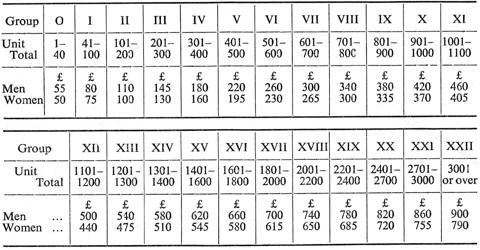 6. (a) In cases where, by reason of the operation of the provisions of subsection 9A(I)(e) of the Burnham Primary and Secondary Schools Report, 1948 (see Appendix VIII), the head teacher was eligible to receive on 31st March, 1951, a higher salary than the total remuneration payable under the other provisions of this Section, such higher salary will continue to be payable until the teacher ceases to be head teacher of the same school, or until 31st March, 1952, whichever is the earlier. (b) In any such case, it is a condition of the continued payment of the higher remuneration provided under paragraph 6(a) above, that the teacher has not, for reasons which do not satisfy the Authority, refused transfer to another school in respect of which appointment he would have received, by the application of the provisions of this Report, a total salary at the same or a higher rate. 7. (a) An allowance may be paid to an assistant teacher who takes charge of a school or department in the absence of the regular head teacher or pending the appointment of a new head teacher. Such allowance is payable only during the period when the assistant takes charge of the school, and should be subject to such maximum limits as will ensure that the total rate of remuneration is not in excess of that which would be payable to the teacher if appointed as head teacher of the particular school or department. An allowance to a head teacher may similarly be paid when he/she temporarily fills the head teacher post of a school or department for which the Head Teacher Allowance is higher than that payable to him/her immediately prior to transfer. (b) A local education authority may fill temporarily vacant head teacher posts by retaining on its permanent "supply staff" one or more teachers paid at the rates applicable to head teachers of schools or departments in Groups O, I or II. [page 7] SALARIES OF QUALIFIED HEAD TEACHERS OF SPECIAL SCHOOLS 1. Qualified Head Teachers of Special Schools shall receive the salaries payable to them as Qualified Teachers under the conditions of Section B and paragraphs 1 to 4 and 6 of Section C together with a Head Teacher Allowance. 2. The provisions of paragraphs 2, 4, 6 and 7(a) of Section J are applicable. The basis for calculating the "unit total" shall be as laid down for Special Schools in Appendix VII. 3. The amounts of the Head Teacher Allowances shall be as follows: 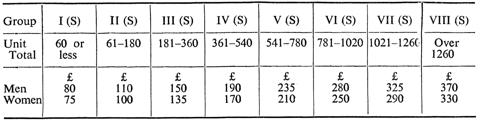 SALARIES OF UNQUALIFIED HEAD TEACHERS OF PRIMARY AND SECONDARY SCHOOLS, OTHER THAN SPECIAL SCHOOLS 1. Unqualified Head Teachers of such schools are those whose employment is approved under Regulation 15(3)(d) of the Primary and Secondary Schools (Grant Conditions) Regulations or the corresponding Regulations in force from time to time. 2. The salaries will be those payable as Unqualified Assistant Teachers under Section D and paragraph 3 of Section E together with a Head Teacher Allowance of £55 in the case of men and £50 in the case of women. 3. A Superintendent Teacher of a Nursery School is classed as a Head Teacher for salary purposes. SALARIES OF UNQUALIFIED HEAD TEACHERS OF SPECIAL SCHOOLS The salaries of Unqualified Head Teachers of Special Schools will be those payable as Unqualified Assistant Teachers under Sections D and E (except that paragraph 5 of Section C is not, in any case, applicable) together with a Head Teacher Allowance of £80 in the case of men and £75 in the case of women. [page 8] SPECIAL ALLOWANCES 1. For Teachers in Primary and Secondary Schools or Departments, other than Special Schools. Prescribed ranges of expenditure upon allowances for individual schools or departments. (a) For assistant teachers there shall be special allowances (over and above the remuneration otherwise payable) for special responsibility, special work of an advanced character, special academic, professional or industrial qualifications, or for other masons which in the opinion of the Authority justify such allowances. Allowances shall not be granted in such manner as would effect a general alteration of the operation of the salary scales.
For schools or departments with unit totals exceeding 400, there shall be additions to the last named ranges of £80 and £120 in respect of each 100 units, one-fifth of the appropriate addition being allowed for each 20, or part of 20, in excess of a complete 100. The appropriate additions are:
A Table showing in more detail the ranges of amounts appropriate to schools according to their unit totals is given in Appendix VII. [page 9] 2. For Teachers in Special Schools (a) For assistant teachers in Special Schools there shall be special allowances (over and above the remuneration otherwise payable) for special responsibility, special work of an advanced character, special academic, professional or industrial qualifications, or for other reasons which in the opinion of the Authority justify such allowances. Allowances shall not be granted in such manner as would effect a general alteration of the operation of the salary scales. (b) No such allowance shall be at a rate less than £40 per annum. (c) The expenditure upon allowances for teachers in Special Schools shall be a charge upon the "Area Pool" available to the Local Education Authority under paragraph 3 below. 3. "Area Pool" (a) In addition to the ranges of expenditure for individual schools or departments within which allowances are payable to assistant teachers under the provisions of paragraph 1 above, for each local education authority area there shall be a sum within which payments made in accordance with the other provisions of this Section shall fall. (b) This sum (which is described herein as the "Area Pool"), for any financial year beginning on 1st April, shall be calculated on the basis of four shillings [20p] for each pupil enrolled on the registers of the Primary, Secondary and Special Schools or Departments maintained by the Authority, and schools assisted by the Authority under Regulation 27 of the Primary and Secondary Schools (Grant Conditions) Regulations, taken together, the number of enrolled pupils being that shown on Ministry of Education Forms 7 (Schools) submitted after 1st January immediately preceding the financial year together with the number of enrolled children in Nursery Schools and Special Schools maintained by the Local Education Authority as at the date taken for the purposes of Forms 7 (Schools). (c) Payments out of the "Area Pool", as in the case of other special allowances, are subject to the condition that they shall not be granted in such manner as would effect a general alteration of the operation of the salary scales. (d) In order to meet the particular needs of a Primary, Secondary or Special School or Department, the Local Education Authority may make special allowances, for purposes such as those indicated below, in addition to the allowances which are payable in accordance with the other provisions of this Section. (i) to pay increased allowances or additional allowances to assistant teachers involving expenditure in excess of the upper range of the school allocation of allowance expenditure; [page 10] allowance. (The Committee draw the attention of local education authorities to the future change of date for the calculation of "unit totals" - see paragraph 1 of Part A of Appendix VII - and to the possible effects, in relation to Infants' Schools and other Primary Schools admitting infants, arising from admissions of children after the first day of opening in January.)(e) A teacher who, on 31st March, 1951, was in receipt of an allowance awarded under Section 4(a) of the 1920 Secondary Report or Section 4(3)(a) of the 1921 Technical Report of the Burnham Committee shall, so long as he/she remains on the staff of the school, continue to receive an allowance over and above the scale salary at a rate not less than that which the teacher was entitled to receive on 31st March, 1951, under Section 8(b) of the Burnham Primary and Secondary Schools Report, 1948 (see Appendix VIII). ADDITIONAL PAYMENTS FOR TEACHERS IN THE "LONDON AREA" 1. There shall be additional payments for teachers serving in the "London Area" as defined in paragraph 3 of this Section. Such payments shall be at the rate of £36 per annum, provided that as from the date on which the teacher has completed 16 years of full-time service in the "London Area" or elsewhere, or has attained the age of 37 years, whichever is the earlier, the rate shall be raised to £48 per annum. 2. Teachers serving in schools situated outside the "London Area" are not entitled to receive the additional payments, except that teachers normally serving in the "London Area", but temporarily employed by a "London Area" authority elsewhere, are so entitled. 3. The following areas shall be deemed to constitute the "London Area": (a) The Administrative County of London. [page 11] 4. Teachers who were employed on 31st March, 1945, by the Borough of Erith Part III Authority shall, provided they continued to serve in the schools in the area of the former Authority until 31st March, 1951, and for so long as they continue so to serve, receive an addition to the salary otherwise appropriate to them under the provisions of the salary scales. The amount of such addition shall be the difference between the scale salary which would have been applicable to them at any time under Scale III and Scale IV respectively of the Report of the Burnham Elementary Committee, 1938. 5. The Burnham Committee has agreed to establish a Tribunal of independent persons to consider and make recommendations relating to (a) the "London Area" and (b) territorial allowances. When the report of this Tribunal is received the position will be further considered by the Burnham Committee. WITHHOLDING OF INCREMENTS No increment shall be withheld in respect of any year unless the service for that year has been declared unsatisfactory by the Local Education Authority. The withholding of an increment under this Section shall be limited in its effect on the salary payable for the one year during which the increment is withheld, unless the Local Education Authority otherwise expressly determines. SALARIES OF "EXISTING TEACHERS" 1. Except where expressly provided elsewhere in the conditions of the salary scales, no teacher in service on 31st March, 1951, shall receive, by reason of the operation of these scales, a smaller rate of salary than he/she would have been eligible to receive under the operation of the Burnham Report as in force on that date. 2. For the purpose of the foregoing provision, "salary" as at 31st March, 1951, does not include an allowance granted under Section 8(a) of the Burnham Primary and Secondary Schools Report, 1948. (See Appendix VIII.) DURATION OF THE SCALES These scales come into force on 1st April, 1951, and shall continue in operation until 31st March, 1954, and thereafter from year to year unless either Panel shall give to the other Panel not less than one year's notice in writing to terminate the operation of the scales on the 31st March in any year. COMMITTEE OF REFERENCE There shall be appointed a Joint Committee of Reference, consisting of 10 members nominated by the representatives of local education authorities on the Committee, and 10 members nominated by the representatives of the Teachers, and the Honorary Secretaries ex officio; to which Committee shall stand referred for consideration and report to the Burnham Committee any matter relating to the interpretation of the provisions of this Report brought forward by a local education authority acting through the Authorities' Panel or by any association of teachers acting through the Teachers' Panel or by consent of the Chairman of the Burnham Committee. [page 12] 1. Assessment of the salaries of teachers who build up full-time teaching service by combining service in Primary and Secondary Schools and in Establishments for Further Education which are covered by the scales for full-time teachers in such Establishments. Where full-time service of each type would be remunerated at different rates, the salary shall be computed as follows: teachers who devote one-half or more of their time to the more highly paid service shall be paid at the higher rate for all work; in other cases payment shall be made at the lower rate for all work.2. Teachers who are appointed on a day-to-day or other short notice basis. The Committee recommend to local education authorities: (a) that such teachers should be remunerated according to their qualifications and experience at a daily or weekly rate calculated by reference to the number of days or weeks during which the school is open in the year; e.g., where a school is open for 200 days during 40 weeks:Daily rate: 1/200th of annual rate.(b) that a teacher paid on this basis and employed continuously throughout the year by the same Local Education Authority should not receive a total salary in excess of or less than the salary payable in accordance with the prescribed scale in respect of the year's service. Method of computing the number of increments in respect of service in the current capacity in determining the salary applicable to a teacher on the appropriate salary scale. 1. The conditions in this Appendix and those in respect of war service in Appendix III relate to teaching service, or other service or experience (which is accepted as equivalent to teaching service) in respect of which increments are payable to a teacher on the salary scale applicable in his/her current capacity. Increments accrue on completion of years of service which are so recognised. 2. The provisions of this Appendix have no application in determining the service or experience which is to be taken into account in assessing the addition to the minimum of the appropriate scales for Qualified, Unqualified and Temporary Teachers which is provided by paragraph 4 of Section C, paragraph 3 of Section E and paragraph 3 of Section H. Conditions which govern the assessment of such additions are set out in Appendix VII, but the over-riding limitation in paragraph 2 of that Appendix should be noted. 3. The scale upon which service under the National Service Act, service as a Reservist and a period of disablement shall be counted (such service and disablement being reckoned as equivalent to teaching service subject to the conditions of paragraphs 10, 11 and 12 of Part C of this Appendix) is the scale appropriate to the status of the teacher upon his/her subsequent entry or re-entry into teaching service; provided, however, that if the teacher should at some later date obtain the status of Qualified Teacher all the service and disablement which is reckonable under paragraphs 10, 11 and 12 below shall thereafter be counted for increments on the scale for Qualified Teachers. 4. The Committee recommend local education authorities to adopt 1st April as a uniform incremental date. In adjusting salaries the general principle which applies is that teachers who remain continuously in service throughout a year beginning on 1st April shall receive the same salary in respect of that year as if increments were given on individual incremental dates on completing an [page 13] integral number of years of service. In reckoning service for this purpose the number of odd days should be ignored or counted as one month according as it is, or is not less than 15, i.e., the date of completion of a year's service should be taken as the first of the month which is nearest to the actual date. In conformity with this general principle, the calculation of salary in the case of migrants and of teachers discontinuing service and resuming it in the same area is that teachers of the same qualifications and the same amount of service at any particular time who are employed by the same Local Education Authority in similar conditions should have the same rate of salary. This rate is, therefore, determined by considering what salary an existing teacher would be receiving who had been continuously employed in the area and had the same service as the migrant at the date of appointment. An exception to this rule is made in a case where the salary of a teacher has been assessed for a year beginning on 1st April and he/she has subsequently a break in service during that year. Provided the teacher resumes service after the break under the same Authority and in the same status, the rate as so assessed is retained for the remainder of the year. 5. Aggregation for increment purposes of periods of service of less than one year shall be in accordance with the following arrangements: (a) The complete calendar months shall be totalled.6. Part-time teaching service. In calculating the salary of a teacher a proportionate increment may be given for previous part-time teaching service (e.g., one increment for two years' half-time teaching service) subject to the condition that, where part-time teaching was concurrent with other service or experience which can be counted for increment, not more than one increment on the appropriate scale shall, in the aggregate, be given in respect of a year of a teacher's life. The recognition or non-recognition for increments on the appropriate salary scale of teaching service, and of other experience or employment for the purpose of assessing the correct position of a teacher on that scale. Note. War Service is recognised for this purpose as equivalent to teaching service subject to the special conditions set out in Appendix III. 1. In determining the correct position of a teacher at any time on the appropriate scales, as laid down in Sections B, D and G, the following service shall be taken into account: (a) Service of the types and under the conditions in Part C of this Appendix. General Conditions 1. No period shall rank both as a period in respect of which an increment for teaching or other service accrues and as a period recognised for the purposes of the addition to scale salary in respect of training as provided by paragraph 2 of Section C. 2. No period of service under the age of 18 years shall be recognised in any capacity under this Appendix. 3. The following are examples of service which is not teaching service for increments under the conditions of this Appendix but which may be dealt with by the Local Education Authority under the provisions of paragraph 8 of this Part of this Appendix: (a) Service as Private Tutor. [page 14] (b) Service in Nursery Schools or Classes, War-time Nurseries, War-time Nursery Classes, Residential or Day Nurseries as Nursery Assistant or in a capacity other than that of teacher. 4. Teaching service in the following classes of educational institutions which are grant-aided or recognised as efficient in England and Wales, and the corresponding institutions in Scotland, Northern Ireland, the Republic of Ireland, the Isle of Man, Guernsey and Jersey: Primary Schools;5. Service in a school or educational institution in England or Wales during a period prior to its recognition as efficient by the Ministry may be accepted if the Local Education Authority, after making full enquiries, so decides. 6. Teaching service of the following kinds: (a) In other schools or institutions in the United Kingdom or elsewhere within the British Commonwealth, or the Republic of Ireland, in Egypt, or in the Sudan, which the Local Education Authority, after making full enquiries, is satisfied may properly be regarded as of equivalent standard to schools, etc., of any of the types defined in paragraph 4 above. (For this purpose the areas under British Mandate are regarded as within the British Commonwealth.) [page 15] 7. Service which has been accepted by the Ministry as that of an Organiser under Section 14 of the Teachers (Superannuation) Act, 1925, or Section 2 of the Teachers (Superannuation) Act, 1945, or under any Scheme made by the Minister under Section 21 of the Teachers (Superannuation) Act, 1925, or service which has been approved by the Minister for the purposes of Section 12(1) of the Superannuation (Miscellaneous Provisions) Act, 1948.(ii) A year spent in a foreign country under the Ministry of Education Scheme (or any corresponding arrangements made by the Scottish Education Department or the Ministry of Education, Northern Ireland) in the capacity of a Senior Assistant.(e) In Naval, Marine and Dockyard schools, and service as Instructor Officer or Schoolmaster R.N., or corresponding service in the Women's Royal Naval Service; in Royal Air Force Educational Institutions; in schools conducted by the Admiralty, War Office or Air Ministry for the education of children of members of H.M. Forces; in Institutions controlled by the Army Council in so far as service is in connection with the academic part of the instruction; in the Royal Army Educational Corps; in the Royal Air Force as Education Officer or as Officer in the Physical Fitness Branch. 8. Time spent in industry or commerce or in professional or research work after the age of 21 years, where likely to be of value to the teacher in the performance of his/her duties may be approved by the Local Education Authority in its discretion and, if so approved, shall be given incremental value up to a maximum of ten increments. (See also paragraph 4 of Part A of Appendix V and paragraph 2 of Appendix VI.) 9. Time spent by an emergency trained teacher on a special course of further training of one or two terms under the Emergency Training Scheme. 10. National Service under the provisions of the National Service Act, 1948, or any amendments of that Act. 11. Any period of whole-time service in His Majesty's Naval, Military or Air Forces rendered after 31st March, 1949, by a person in pursuance of his or her obligations as a member of His Majesty's Reserve or Auxiliary Forces, or the Women's Royal Naval Reserve, or in pursuance of a duty to return to such whole-time service after release therefrom. 12. A period of disablement, not exceeding three years, provided that satisfactory evidence is produced that the teacher was unable to undertake teaching duties, or to complete his preparation for the teaching profession, owing to disabilities contracted as a result of service as defined in paragraphs 10 and 11 above. War Service recognised for the purposes of increments as equivalent to teaching service War Service in the period between 1939 and 1949 1. War service of the following kinds shall be reckoned as equivalent to teaching service: (a) Service in any of the naval, military and air forces of the Crown.2. The scale upon which the war service shall be counted for increment shall be the scale appropriate to the status of the teacher when he/she enters upon or resumes employment as a full-time teacher after completion of his/her war service; provided, however, that if the teacher obtains subsequently a qualification (other [page 16] than under paragraph 10(viii) of the Ministry's Circular 30 or paragraph 6 of Circular 173) entitling him/her to be approved as a qualified teacher, the war service shall be counted on the scale appropriate to him/her after obtaining such qualification. In cases excepted from the foregoing proviso, increments do not accrue in respect of a period of war service which has been taken into account as part of the qualification for the status of Qualified Teacher. 3. The following conditions are applicable in connection with the counting of war service for increment: (a) Service before the age of 18 years shall not be counted. War Service in the previous war beginning in 1914 War service rendered by teachers during the previous war beginning in 1914 is recognised within the limits and under the conditions specified in Appendix V of the Burnham Reports of 1938 (see Appendix VIII). Courses of Approved Study or Training General conditions governing the acceptance of periods of study and/or training for the purpose of the addition to the basic scale 1. No period may rank both as a period in respect of which an increment for teaching service accrues and as a period recognised for the purposes of paragraph 2 of Section C. 2. The courses of study or training referred to in Part B of this Appendix are full-time courses at Universities, University Colleges, Training Colleges, Technical (including Commercial) Colleges, Art Colleges or Art Schools, or other Institutions recognised for the purpose. 3. The period of any particular course should be interpreted as meaning the normal period of full-time study or training required to complete the course satisfactorily. An extension of a course by reason of the repetition of some part of it is not accepted. [page 17] 4. The following may be counted in the same way as a year of training (see also paragraph 6(d)(i) of Part C of Appendix II): (a) A year spent under the Ministry of Education Scheme (and corresponding Schemes under the Board of Education, the Scottish Education Department and the Ministry of Education, Northern Ireland), in France in the capacity of Assistant (Assistante) or Répétiteur (Répétrice) or as Junior Assistant; or the equivalent capacity in another foreign country.5. A three-year course under Article 25(a) of the Scottish Training Regulations does not qualify for an additional increment. 6. A period of full-time study and/or training which was undertaken by a teacher before the age limits specified below should not be taken into account for the purposes of this Appendix, Not less than 17 years of age, (a) at 1st October in the first year of a course beginning at the Autumn Term, orWhere none of these conditions is satisfied, the study/training eligible to be taken into consideration is that pursued by the student after attaining the age of 17 years. 7. Tire words "or the equivalent" in paragraph 2(a) of Part B of this Appendix refer to a concurrent four-years' course of training in teaching and study for a degree. 8. Training in teaching which preceded, as well as that which followed, a full-time course of study for a degree is accepted. Examples of courses and periods of study and/or training which are approved by the Committee 1. Entitling the teacher to the addition of one increment. (a) Three-year courses at Training Colleges leading to the status of Qualified Teacher. (b) A three-year course in preparation for the teacher's certificate of the National Froebel Union or Foundation, provided that the date of entry upon the course was not earlier than 1946. (c) Two-year courses at Training Colleges leading to the status of Qualified Teacher supplemented by a recognised third-year course. (d) Three-year courses at the following Physical Training Colleges: Chelsea Physical Training College (now at Eastbourne) Courses commenced 1909 or later.(e) Three years' full-time study resulting in the award of a Degree; or two years' full-time study resulting in the award of a Degree, followed by a further year of approved training or of post-graduate study, advanced work or research in the same Institution or under the supervision of an Institution of similar standing. [page 18] (f) Three years' full-time study resulting in the award of a Diploma or Certificate at an Establishment for Further Education or other Institution accepted by the Committee for the purpose. The following have so far been accepted by the Committee:
(g) Three years' full-time study resulting in the award of a National Diploma. (h) Three years' full-time study spent in obtaining one of the qualifications specified in Appendix V. (j) A one-year course of training under the Emergency Scheme (Board of Education Circular 1652), or a course of "Special Training" for uncertificated and other teachers (Ministry of Education Circular 114), under Grant Regulations No. 7B together with a one-year full-time course approved for the purpose. 2. Entitling the teacher to the addition of two increments. (a) Three years' full-time study resulting in the award of a Degree or a Diploma approved for the purpose, and in addition a year of training in teaching; or the equivalent. (b) Four years' full-time study resulting in the award of a Degree or Diploma approved for the purpose, or a period of full-time study resulting in the award of a Degree or an approved Diploma, followed by post-graduate study, advanced work or research in the same Institution or under the supervision of an Institution of similar standing and amounting in the aggregate to not less than four years. (c) Two-year courses at Training Colleges leading to the status of Qualified Teacher, supplemented by a full-time two-year course resulting in the award of a Degree. (d) Four years' full-time study spent in obtaining one of the qualifications specified in Appendix V. 3. Entitling the teacher to the addition of three increments. (a) Four years' full-time study resulting in the award of a Degree or Diploma approved for the purpose, together with a recognised one-year course of training in teaching; or a period of full-time study resulting in the award of a Degree or an approved Diploma, followed by post-graduate study, advanced work or research in the same Institution or under the supervision of an Institution of similar standing and amounting in the aggregate to not less less than five years. (b) Five years or more full-time study spent in obtaining one of the qualifications specified in Appendix V provided that five years is the normal period of study for such qualification. Miscellaneous provisions 1. Shortened or accelerated courses. Where, owing to war conditions, a course of any of the types mentioned above has been compressed into a period of less than three, four or five years respectively, there shall be allowed in respect of each period of one term by which the duration of such course exceeds two, three or four academic years respectively, one-third of the appropriate increment. [page 19] 2. Other courses of study and/or training. (a) Courses similar in duration and otherwise equivalent to those referred to in Part B of this Appendix, whether completed in England and Wales or elsewhere, may also be accepted, and full details of such cases should be submitted to the Minister for decision. Such decisions already given under the corresponding provision in the Committee's Reports for 1945 and 1948 shall continue to apply provided, however, that they satisfy the general relevant conditions in Part A of this Appendix. (b) Other courses of study and/or training may also be accepted if they are of such a duration and character as are desirable for full-time teachers under this Report and are approved by the Burnham Committee for the purpose, Qualifications Entitling a Qualified Teacher to be Classed as a Graduate for Salary Purposes General conditions attaching to the application of the provisions of Part B of this Appendix 1. Teachers who have passed the requisite final examination and complied with the other conditions for the award of a University degree are classed as graduates for salary purposes even though the degree has not been conferred upon them by the University. 2. Holders of the following qualifications are not regarded as entitled to be classed as graduates for salary purposes under the conditions of paragraph 2 of Part B of this Appendix. (a) L.L.A. (St. Andrews);3. In cases where the qualifications listed in Part B of this Appendix are approved as qualifications entitling a teacher to be classed as a graduate for salary purposes subject to the specific condition that the teacher has attained an acceptable standard of general education, this standard, in terms of the General Certificate of Education, shall normally be that which is accepted by the Ministry of Education for candidates seeking admission to Training Colleges (Ministry of Education Circular 213). Other qualifications may, however, in special cases be accepted if approved by the Ministry for the purpose. 4. A period of professional experience which is a requisite part of a qualification for graduate status is not on that account ineligible to be reckoned for increments of salary, provided that not more than two increments may be granted in respect of such period. In respect of teachers in service on 31st March, 1945, teaching service may be reckoned towards the period of requisite professional experience. See paragraph 7(g), (o) and (t) of Part B of this Appendix. Increments allowed under this paragraph are subject to the overriding limits of paragraph 2(b) of Appendix VI. The following qualifications shall entitle a teacher, whose qualifications are accepted by the Ministry for the status of Qualified Teacher, to be classed as a graduate for the purposes of Section C. 1. Qualifications for graduate status for salary purposes recognised under Reports of the Burnham Committee before 1945, and continuing to be so recognised. (a) Recognition under the terms of: (i) Sections 8, 9 or 10 of the 1920 and 1927 Secondary Reports, or the corresponding Sections of the 1921 and 1927 Technical Reports (see Appendix VIII)2. University Degrees, etc. (a) Degrees, other than honorary degrees, of: (i) English, Welsh, Scottish and Irish Universities [page 20] (iii) Dominion, Colonial and other Universities provided the standard of the degree (or equivalent qualification otherwise described) approximates to that of an English University. In the case of such qualifications reference should be made to the Ministry of Education for decision unless in any particular case the qualification held by the teacher has already been considered for this purpose in consultation with the Ministry.3. Architecture Associateship of the Royal Institute of British Architects provided the teacher has passed the Examination of the Institute, or an examination accepted by the Institute as giving exemption from its own examination. 4. Art (a) The Art Teachers' Diploma, or the Teaching Certificate for Teachers in Schools of Art, issued by the Ministry of Education or the Board of Education under the provisions of Rules 109, or of Circular 1214, or - for teachers who have rendered meritorious service as teachers of Art, and who became Certificated Teachers College-trained not later than 1st August, 1923 - the qualifications required for the Diploma or Teaching Certificate referred to above, without the completion of the prescribed course of professional training and the passing of an examination in the Principles of Teaching and School Management. (b) The London University Diploma in Fine Art (Slade School) provided (i) that it has been endorsed under the provisions of Rules 109, or
(c) (i) The Diploma of Associateship of the Royal College of Art (A.R.C.A.)
provided that, in each case, the teacher is regarded by the Ministry of Education as having satisfied the requirements of paragraph 2 of Rules 109 (d) The Full Associateship of the Royal College of Art. (This qualification is not now awarded) (e) The Art Masters' Certificate, Group I, if awarded under the Rules of 1901 and subsequent years (This qualification is not now awarded) (f) (i) The Specialist Art Teachers' Diploma of the Edinburgh College of Art
provided that, in each case, the student entered upon the Course at the College not later than 1947, and that he/she holds the Certificate of Training at the Edinburgh Provincial Training Centre obtained under the Scheme which came into force on 1st October, 1926. (g) (i) Rome Scholars
provided that, in each case, they have satisfactorily completed a two-year course of full-time foreign study under supervision approved by the Royal Commissioners for the Exhibition of 1851. (h) The Secondary Teachers' Art Certificate of the University of Oxford provided that the requirement of a year's professional training bas been fulfilled. (This qualification is not now awarded.) 5. Modern Languages (a) French (i) Licence ès Lettres(b) Other Languages A qualification of equivalent standard to those recommended for French. 6. Music (a) Graduate of the Royal Schools of Music (London)
[page 21] (d) Licentiateship of the Royal Academy of Music with special Teaching Diploma of the Academy
provided that (i) in the case of the qualifications (b) to (e) inclusive, the students entered upon their courses not later than the Session 1929-1930; (ii) in the case of the qualifications (b) to (j) inclusive, at least three years after the age of 18 were spent in full-time study in the courses provided by the Academy, Colleges or Schools, and that the teacher has attained a standard of general education to the level of the School Certificate examination, or its equivalent. Note: Holders of honorary distinctions of the Royal Academy and Royal College of Music (including the Associateship of the Royal Academy not by examination) will continue to be regarded as graduates for salary purposes if at a date not later than 31st December, 1929, they had approved teaching service in that status. 7. Other Professional Qualifications (a) Associateship of the Royal College of Science (London)
(i) The Institution of Civil Engineersprovided that in the cases of (e) (i), (ii) and (iii) the Associate Member has passed the Associate Membership Examination, or an examination accepted by the Institution as giving exemption from the Associate Membership Examination. (f) Associate Membership of the Institution of Structural Engineers provided (i) the Associate Member has passed the Associate Membership Examination after 1st April, 1935, or an examination accepted after that date by the Institution as giving exemption from the Associate Membership Examination; and(g) Associateship of the Royal Institution of Chartered Surveyors (formerly Professional Associate of the Surveyors Institution) provided that the teacher has had four years' professional experience after passing the examination. (See paragraph 4 of Part A of this Appendix.) (ii) Associate Membership of Town Planning Institute by examination provided (i) the teacher has attained a standard of generaI education to the level of the School Certificate examination, or its equivalent; and either [page 22] (j) Associateship of the Institute of Builders provided (i) that the Associate Member has passed the Final Examination or an examination accepted by the Institute as giving exemption from the Final Examination; and(k) Associateship of the Royal School of Mines (l) Associate Membership of the Institution of Mining Engineers by examination (m) The First Class Colliery Managers' Certificate together with the Diploma of a Mining College recognised by the Ministry of Fuel and Power (n) Associateship of the Institution of Metallurgists if obtained after examination held in or after August, 1949 (o) (i) Barristers (Bar Final)
provided that, in each case, the teacher has had four years' professional experience after passing the examination. (See paragraph 4 of Part A of this Appendix.) (p) M.R.C.S., L.R.C.P. Diploma (q) (i) Associateship of the Institute of Physics
provided that, in each case, the Associate has passed the Institute's Examination for Associateship or an examination accepted by the Institute as giving exemption from the Associateship Examination (iii) The Pharmaceutical Chemist qualification (by examination) of the Pharmaceutical Society of Great Britain (r) Honours Diploma F.S.M.C. if obtained after examination (s) Associateship of the Textile Institute provided that the Associate has passed the Preliminary Examination or equivalent educational qualification recognised by the Institute, and the examination in General Textile Technology. (t) (i) Associateship of the Institute of Chartered Accountants
provided that, in each case, (a) the Associate has passed the Final Examination or an examination accepted by the Institute or Society as giving exemption from the Final Examination, (b) the teacher has attained a standard of general education to the level of the School Certificate examination, or its equivalent, (c) the teacher has had four years' professional experience after obtaining the qualification. (See paragraph 4 of Part A of this Appendix.) (iv) Associateship of the Association of Certified and Corporate Accountants subject to the foregoing provisos (a) and (b) and provided that the teacher has had five years' professional experience after obtaining the qualification. (See paragraph 4 of Part A of this Appendix.) (u) Fellowship of the Library Association (v) (i) The Extra Master's Certificate of Competency of the Ministry of Transport by examination passed after 1st March, 1931
(w) Qualifications obtained by officers and non-commissioned officers who have reached ranks in His Majesty's Forces promotion to which has followed a course of study or training which the Committee, in agreement with the Minister, accept as equivalent to courses of study resulting in the award of a degree. 8. Other industrial, commercial or professional qualifications and experience which are accepted by the Committee in agreement with the Minister. [page 23] Conditions governing the addition to the minimum of the Qualified Teacher Scale in respect of experience gained prior to the date of qualification for the status of Qualified Teacher, and to the minimum of the scales for Unqualified and Temporary Teachers. 1. In applying the provisions of paragraphs 4 (a), (b) and (c) of Section C, of paragraph 3 of Section E and paragraph 3 of Section H, a period of 11 months 15 days or more, or a balance of 11 months 15 days or more in excess of a number of completed years, is reckoned as a complete year. Further, in assessing the additions to the minimum in respect of "each period of three years", a period, being not less than three years, exceeds a multiple of three by not less than two, it shall be treated as if it were the next higher multiple of three. 2. In the case of Qualified Teachers, war service which, under the conditions of Appendix III, is eligible to be reckoned for increments on the Qualified Teacher scale, shall not be taken into account in determining the maximum number of increments allowable in accordance with sub-paragraphs (a) and (b) below, subject however to the special provisions of paragraph 3(d) of Part A of Appendix Ill. (a) In applying the provisions of paragraphs 4 (b) and (c) of Section C, no teacher shall receive more than 10 increments in respect of experience gained prior to the date of qualification for the status of Qualified Teacher, either (i) for teaching experience, or (ii) for experience of other kinds, or (iii) for teaching and other experience taken together.3. A period which is taken into account for any one of the purposes described in this Appendix should not also be reckoned for any other such purpose. 4. Non-teaching experience of the kind which is taken into account under the provisions of paragraph 4 of Section C shall be completed years (as defined in paragraph 1 of this Appendix) of experience in gainful employment. Unit Totals 1. "Unit total" of a school or department for any year is a figure as assessed by reference, firstly, to the number of pupils on the roll of the school or department. For the years up to and including 1952, the roll for this purpose shall be the number of pupils as on the last day of opening of the school or department in March of that year. For the year 1953 and succeeding years, the roll shall be that shown on Ministry of Education Form 7 (Schools) for the year concerned. In the case of a Nursery or Special School, the number on roll shall be as at the date taken for the purposes of Form 7 (Schools). 2. In the case of a Primary or Secondary School or Department, other than a Special School, the number of pupils as thus ascertained is further classified according to their ages as at 31st March following. For this purpose the age of any pupil at the relevant date shall be determined by reference to the anniversary of his/her birth, e.g., a pupil shall not be deemed to have attained the age of 15 years until the 15th anniversary of his/her birthday. The "unit total " is calculated as follows:
[page 24] 3. In the case of Special Schools, a procedure similar to that described in paragraph 1 above shall be followed. The further classification of the enrolled pupils shall be on the basis of the type or types of special educational treatment provided for the enrolled pupils and not according to their ages. This procedure is applicable equally to a school which is recognised as providing special educational treatment of more than one type, as to a school recognised as providing one type only. The "unit total" is calculated as follows:
4. The unit total is assessed for a school or department and is used as the basis (a) of determining the Head Teacher Allowance for the teacher who is head of the school or department as laid down in Sections J and K, and (b) the total sum to be expended upon allowances for assistant teachers in Primary and Secondary Schools or Departments (but not Special Schools) as laid down in Section N. Conditions of the application of Unit Totals in determining the Head Teacher Allowance for a School or Department. The Provisions in the paragraphs which follow are related to those in Sections J and K. 1. Subject to the conditions of paragraphs 2 and 3 immediately following, the Head Teacher Allowance for the year beginning 1st April, 1951, shall be calculated on the unit total for 1949, and for the three years beginning 1st April, 1952, on the average of the unit totals for the three years 1950, 1951 and 1952 calculated to the nearest whole number. For every three years thereafter, the same procedure shall apply with appropriate adjustment of dates. 2. The Head Teacher Ailowance for tlhe Head of a school or department which was newly opened or reorganised in the period of the operation of the 1948 Report on Scales of Salaries for Teachers in Primary and Secondary Schools shall be assessed, as respects the period up to 31st March, 1955, in accordance with the provisions of Section 9A(1)(d) of that Report (see Appendix VIII). ln the case of a school or department newly opened or reorganised during the years beginning 1st April, 1951, 1952 or 1953, the allowance payable from the date of opening or reorganisation, until the end of the third complete financial year thereafter, shall be based on the estimated unit total for the year in which that period ends. 3. For the purposes of the foregoing provisions, the Committee contemplate that local education authorities will regard a school or department as having been reorganised if (a) a change occurs which alters the character of the organisation in the sense e.g. that it will cater for pupils of different age range or sex, or (b) if, the organisation remaining unchanged, the Authority takes some action in the interests of educational organisation the effect of which would be significantly to add to or reduce the number of children who will normally be enrolled. The latter provision should not be regarded as applicable to a case where, due to circumstances other than those directly resulting from such decision by the Authority, the increase or decline in numbers of pupils is due to other causes. Conditions of the application of Unit Totals for purposes of the payment of special allowances to teachers in Primary and Secondary Schools or Departments, other than Special Schools. The provisions of the paragraphs which follow are related to those in Section N. 1. For the year beginning 1st April, 1951, the prescribed ranges of expenditure upon allowances for teachers in individual schools or departments as laid down in paragraph 1 of Section N shall be assessed by reference to the unit totals for the year 1949. The ranges of such expenditure for the three years beginning 1st April, 1952, shall be assessed by reference to the average of the unit totals for the three years 1950, 1951 and 1952 taken to the nearest whole number, [page 25] 2. In the case of a school or department newly opened or reorganised, the ranges of expenditure for the purposes of paragraph 1 of Section N shall be assessed as follows: (a) For the period from the date of opening or reorganisation until 31st March in the first year for which an actual "unit total" is ascertainable3. The detailed application of the formula in paragraph 1(c) of Section N to schools of various unit totals is set out below. 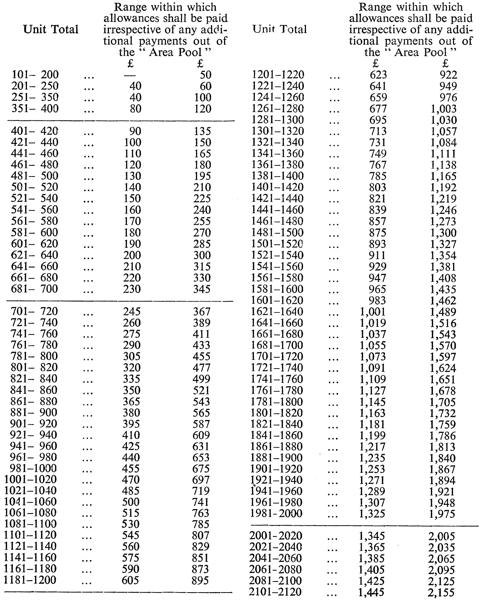 [page 26] 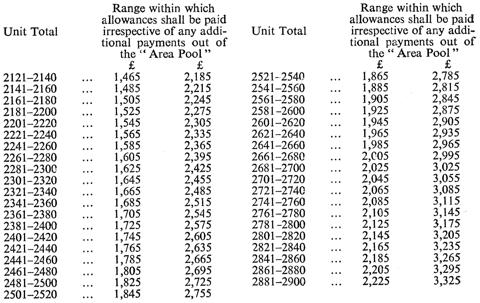 Relevant Extracts from Previous Reports Relevant Sections of previous Reports which are referred to in the main text of this Report are reproduced below. 1. Section 9A(1)(e) of fhe Burnham Primary and Secondary Schools Report, 1948 (to which paragraph 6(a) of Section J of this Report refers): 9A(1)(e)(i) In cases where by reason of the operation of the provisions of the Primary and Secondary Schools Report, 1945, the head teacher was eligible to receive on 31st March, 1948, a higher salary than the total remuneration payable under the other provisions of this Section, such higher salary will continue to be payable until the teacher ceases to be head teacher of the same school, or until 31st March, 1952, whichever is the earlier. (ii) In any such case, it is a condition of the continued payment of the higher remuneration provided in sub-section 9A(1)(e)(i) above that the teacher has not, for reasons which do not satisfy the Authority, refused transfer to another school in respect of which appointment he would have received, by the application of the provisions of this Report, a total salary at the same or a higher rate. 2. Section 4(a) of the 1920 Secondary Report (to which paragraph 3(g) of Section N of this Report refers): "Additions to the above scales (Scales for Assistant Masters and iMistresses).The amounts of £24 and £48 were later substituted for £25 and £50 respectively.(Recommendations appended to the Award of The Rt. Hon. The Viscount Burnham in respect of the salaries of teachers, June, 1925.) Section 6 (a), (b) and (c) of the 1920 Secondary Report reads as follows: "6(a) For the purpose of computing the salary under these scales, a first-class honours degree of any University in the United Kingdom of Great Britain and Ireland shall be recognised as a good honours degree, and successful research work or other post-graduate achievement may be similarly recognised. [page 27] Section 8(b) of the Primary and Secondary Schools Report of 1948 reads as follows: "(b) A teacher who, on 31st March, 1948, was in receipt of an allowance originally awarded under Section 4(a) of the 1920 Secondary Report or Section 4(3)(a) of the 1921 Technical Report of the Burnham Committee shall, so long as he/she remains on the staff of the school, continue to receive an allowance over and above the scale salary at a rate not less than that which the teacher was entitled to receive on 31st March, 1948, under Section 9(b) of the Burnham Primary and Secondary Schools Report, 1945, provided that such an allowance shall not be held concurrently with an addition under sub-section 4(c)(ii) of this Report.3. Section 8(a) of the Burnham Primary and Secondary Schools Report, 1948 (to which paragraph 2 of Section Q of this Report refers): 8.(a) For assistant teachers there shall be special posts in respect of which allowances over and above the scale salary shall be granted for special responsibility, special work of an advanced character, special academic, professional or industrial qualifications, or other circumstances which in the opinion of the Authority justify an addition to the scale. Allowances over and above the scale salary for assistant teachers shall not be granted in such manner as would effect a general alteration in the operation of the scales.4. Appendix V of the Elementary and Secondary Reports of 1938 (to which Part B of Appendix III to this Report refers). Appendix V of Burnham Elementary Report, 1938. Men Teachers 1. In respect of teachers who fall into the categories referred to in paragraphs 2, 3, 4, 5 and 6 below, War Service of the following kinds may be reckoned as equivalent to teaching service: (a) War Service (as soldiers, sailors or airmen) with H.M. Forces.*The Committee understand that the Minister will from time to time examine the schemes adopted for this purpose by Local Education Authorities. †For this purpose teachers who are employed full-time but who spend three-quarters or more of their time in service in schools to which this Report relates shall be deemed to be in full-time service in such schools. Teachers who spend more than one-quarter but less than three-quarters of their time in service in such schools shall be treated for the purpose of this Section as if two such teachers were equivalent to one full-time teacher. Teachers who spend one-quarter or less of their time in schools to which this Report relates shall not be included. [page 28] 2. Men who before enlistment were recognised as teachers in England and Wales or in Scotland, and were serving in one of the institutions mentioned in Appendix IV, either immediately before enlistment or immediately after demobilisation. In these cases the war service will normally be counted as equivalent to teaching service in the capacity in which the teacher was recognised before his entry on war service. 3. In the following cases where teachers were in definite stages of acquiring qualifications for employment as Certificated Teacher, and would, in the ordinary course, have obtained permanent employment in that capacity at a considerably earlier date if they had not joined the Forces, war service may be reckoned as equivalent to teaching service as a Certificated Teacher: (a) Students whose Training College course was interrupted during the War, and who either completed a course satisfactorily after demobilisation, or were given a Provisional Certificate;4. Consideration on merits is also given to the case of any teacher who does not satisfy (3) above, provided that the teacher became Certificated at the earliest opportunity after demobilisation and can produce substantial evidence, beyond that indicated, for example, by mere tenure of a Bursarship or Student or Pupil-Teachership, that he was in a definite stage of acquiring qualifications for recognition as a Certificated Teacher before joining the Forces. 5. In the case of Handicraft Teachers who before enlistment were undergoing a course of training in a Training College for Handicraft (e.g., Shoreditch or one of the Scottish Training Colleges), and whose course of training was interrupted by war service, the war service may be counted on the scale which is appropriate to the teachers' status after the War.
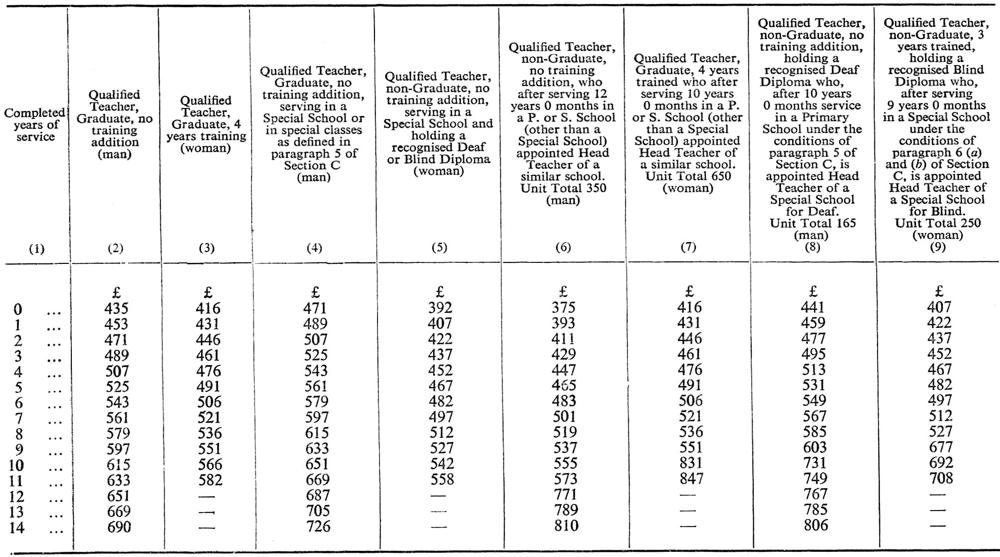
[page 29] 6. Public Elementary School Teachers who immediately before enlistment were serving in approved educational institutions (Appendix IV above) and who at that time held academic qualifications for recognition under the Code, may for this purpose be regarded as though they had been recognised under the Code at the earliest date from which recognition could have been given if all their service had been in Public Elementary Schools. Women Teachers 7. The war service of Women Teachers who have been awarded the Victory Medal may be reckoned as equivalent to teaching service in the capacity in which the teacher was recognised before the War, provided that the service in respect of which that medal was awarded commenced before 14th June, 1917, the date upon which Circular 1003 was issued. General 8. The following conditions are applicable to the teachers mentioned above in connection with the counting of war service: (a) Service before the age of 18 should not be counted. (b) No service for which a teacher volunteered after the Armistice should be counted.* (c) If the total period spent in a Training College by a College-trained teacher falls short of two years, the difference between two years and the period actually spent in the College (both before and after enlistment) should be deducted from any period allowed for war service." Appendix V of Burnham Secondary Report, 1938 1. The following types of war service (see Circulars 1244, 1318 and 1336) may be counted for increment purposes: (a) Service with H.M. Forces (Soldiers, Sailors or Airmen).2. The following are examples of types of war service which are not taken into account for increment purposes: (a) Voluntary periods of service after the Armistice (but provided they do not exceed 12 months in duration, they do not invalidate actual service during the war from being counted).*No general ruling can be given with regard to the date up to which Army Service after the Armistice may be counted for increments on the Standard Scale of Salaries. So far as the Army and Royal Air Force are concerned, it may be assumed that a teacher had no post-Armistice Volunteer Service if he were demobilised before 1st July, 1919. There was no post-Armistice Volunteer service in the Royal Navy. [page 30] 3. The following classes of Teachers are allowed to count war service as defined in paragraph 1 above for increment purposes: (a) Men who were serving as full-time Teachers at the outbreak of the war or later - provided that they resumed such teaching at the first opportunity after demobilisation, or the interval between demobilisation and resuming teaching was occupied by a full-time course of study for a degree, or in preparation for the teaching profession.4. War service is counted for increments on the scale which was appropriate to the Teacher before his entry on war service, except in the following cases: (a) Teachers who proceeded to a University and obtained a degree before resuming teaching are treated as new entrants (see paragraph 3(b) preceding).5. Sections 8, 9 and 10 of the 1927 Secondary Report (to which paragraph 1(a)(i) of Part B of Appendix V to this Report refers): 8. A Local Education Authority in considering the placing of Non-Graduate teachers on the Graduate Scale, should accept a less exacting standard for teachers who were in the service of the Authority on 1st September, 1920. [page 31] 9. In Schools to which this Report relates where there were in force definite scales for Graduates and Non-Graduates prior to 1st September, 1920, or the date of the adoption of the 1920 Report if later, and where a Non-Graduate teacher had been placed by the Local Education Authority on such Graduate Scale, such recognition shall continue in the application of the new scale. 10. In Schools to which this Report relates, the Local Education Authority is recommended to recognise the case of Non-Graduate teachers of adequate educational qualifications whose service in such Schools has been of a meritorious character and who were appointed on or before 1st April, 1912, by placing such Teachers on the Graduate Scale." Sections 7, 8, 9 of the 1921 Technical Report and Sections 8, 9, 10 of the 1920 Secondary and the 1927 Technical Reports are in similar sense. Section 3(3)(a)(ii) of the 1938 Technical Report (to which paragraph 1(a)(ii) of Part B of Appendix V to this Report refers): - "Grade III - Graduate Assistants Assistants in this Grade will be of two kinds: .................Note. The Board's approval must be sought for all cases proposed under (ii)." Section 4(3)(b) of the 1921 Technical Report and Section 3(3)(a)(ii) of the 1927 Technical Report are in similar sense. 6. Section 9A(1)(d) of tile Burnham Primary and Secondary Schools Report, 1948 (to which paragraph 2 of Part B of Appendix VII of this Report refers): 9A(1)(d)(i) In the case of a school newly opened or reorganised* in the year beginning 1st April, 1948, the allowance payable for the period to 31st March, 1952,† shall be assessed by reference to the estimated unit total for 1952. The allowance payable for the next succeeding three years shall be calculated on the unit total for 1952 and thereafter under the provisions of sub-section 9A(1)(c)(iii).*The word "reorganised" shall have the same significance as that which has hitherto been attached to it for this purpose in previous Reports of the Committee. †Subject to the provisions of Section 15 of this Report. [page 32] 1. (a) Basic Scale Salary (without additions) for each year of service. MEN 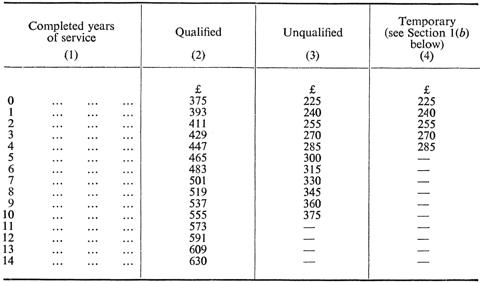 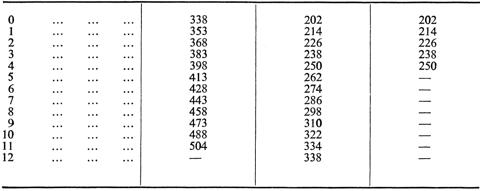 (b) The scale in column (4) applies to Temporary Teachers other than those who are employed in that capacity prior to their entry upon a recognised course of teacher training as provided in Section F. [page 33] 2. For the purposes of illustration, the following representative scales for men and women indicate the method of assessing salary, with additions but without special allowances, on the basis of increments in respect of completed years of service.
(Sgd.) W. P. ALEXANDER (Authorities' Panel) and
(Sgd.) MALCOLM TRUSTRAM EVE (Chairman) 5th March, 1951. [page 34] Paragraphs of the Appendices are indicated by ¶.
[page 35]
[page 36]
[page 37]
[page 38]
[page 39]
[inside back cover]
[back cover]
PRINTED AND PUBLISHED BY HlS MAJESTY'S STATIONERY OFFICE
1951 Price 1s. 6d. net PRINTED IN GREAT BRITAIN 
| |||||||||||||||||||||||||||||||||||||||||||||||||||||||||||||||||||||||||||||||||||||||||||||||||||||||||||||||||||||||||||||||||||||||||||||||||||||||||||||||||||||||||||||||||||||||||||||||||||||||||||||||||||||||||||||||||||||||||||||||||||||||||||||||||||||||||||||||||||||||||||||||||||||||||||||||||||||||||||||||||||||||||||||||||||||||||||||||||||||||||||||||||||||||||||||||||||||||||||||||||||||||||||||||||||||||||||||||||||||||||||||||||||||||||||||||||||||||||||||||||||||||||||||||||||||||||||||||||||||||||||||||||||||||||||||||||||||||||||||||||||||||||||||||||||||||||||||||||||||||||||||||||||||||||||||||||||||||||||||||||||||||||||||||||||||||||||||||||||||||||||||||||||||||||||||||||||||||||||||||||||||||||||||||||||||||||||||||||||||||||||||||||||||||||||||||||||||||||||||||||||||||||||||||||||||||||||||||||||||||||||||||||||||||||||||||||||||||||||||||||||||||||||||||||||||||||||||||||||||||